


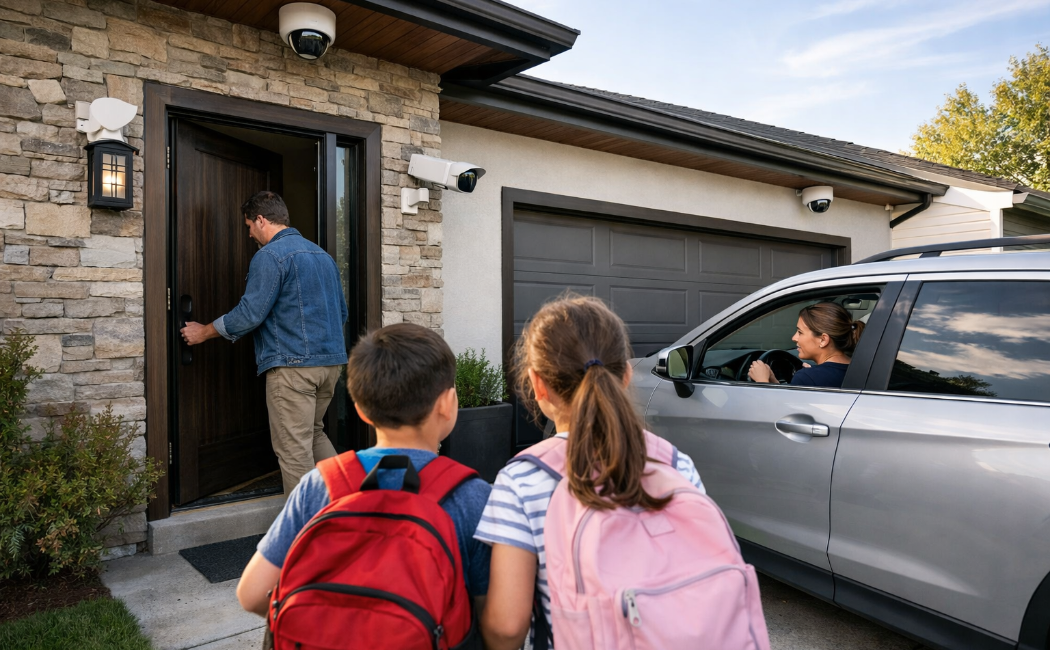
In terms of the security of your home or business, installing surveillance is only half the task. The actual determinants of your surveillance system’s effectiveness are proper camera placement. Even a high-tech surveillance system with advanced security features does not provide sufficient protection when placed in the wrong position. Proper positioning will guarantee maximum coverage and minimise blind spots, and record clear, usable footage at the point when it counts the most.
Professional security installation services come here. Skilled technicians are knowledgeable about property layouts, risk assessment, and technical specifications. They make sure all the cameras are placed to deliver optimal performance for you, giving you better monitoring and peace of mind.
Evaluate Your Property and Risk Zones.
Determine Entrances, Windows, Blind Spots, and High-traffic
You should carefully evaluate your property before installing any type of camera. Pay attention to the entrance and exit points, front doors, back doors, side entries, and garage doors. Ground-level or street-blind windows also should be observed.
Another vital issue is blind spots. These are places that are not normally visible to the naked eye, such as the sides of buildings, fences, or storefronts. There should also be covered areas with high traffic, such as driveways, hallways, reception areas, and parking lots, to track daily activity and identify suspicious behavior.
Priority of Zones According to Threats
Risks do not always occur evenly. Priority should be given to areas that are most susceptible to unauthorised access or in areas where assets of high value are kept. For example, a business would be concerned with cash registers, server rooms, or inventory storage, whereas a homeowner would be concerned with the garage, backyard gates, or basement doors.
By prioritising and classifying risk areas, you can place cameras in strategic locations and eliminate unnecessary redundancy while still achieving maximum coverage.
Types of Cameras and their optimal position.
Dome, Bullet, and PTZ Cameras
The various camera styles are used in different ways. The knowledge of their strengths will assist you in figuring out where they will be most effective:
- Dome Cameras: Dome cameras are best for indoor use, as they offer a wide field of view and are less conspicuous. They are also designed to make it hard for intruders to determine their direction of travel.
- Bullet Cameras: These are more suitable for outdoor use. They are ideal for surveillance of driveways, parking lots, and boundary fences due to their long range.
- PTZ (Pan-Tilt-Zoom) Cameras: PTZ cameras are flexible and enable the operator to control the camera’s direction and zoom. They are perfect for large areas such as warehouses or parking lots.
The Recommended Object Placement of the Best Surveillance Camera Services.
The most appropriate surveillance camera services will analyse your property and recommend the best camera for each area. As an example, they can install dome cameras in the retail aisles, bullet cameras on the outer walls, and PTZ cameras in large outdoor areas. This personalised methodology will be effective, as it will provide full coverage without wasting resources.
Height, Angle, and Field of View
Best Mounting Height and Angles to Minimise Blind Spots.
The mounting height is an important factor in determining the amount of clear footage. Campers should not be set too high, as the surveillance would fail to capture facial features, but they should not be set too low, as they can be easily tampered with. Generally, outdoor survillance are mounted between 8 and 10 feet above ground. The indoor surveillance system can be mounted a notch lower to accommodate the ceiling height.
The angle should not be too steep, and the line of sight must be clear. A low angle of 15 to 30 degrees is usually effective in taking faces and activities in focus.
Eliminating Obstructions and Glare
Ensure there are no obstructions to surveillance systems caused by trees, signs, walls, or decorations. Periodically, ensure that there are no new objects which are within the field of view.
Direct sunlight or reflective surfaces may cause footage to be distorted by glare. An outdoor security system should not be in direct sunlight, and anti-glare housings should be used. In the building, do not aim cameras at the windows or intense lights.
Outdoor vs Indoor Insights.
Lighting Conditions, Motion Detection Sensitivity, and Weatherproofing.
Outdoor surveillance should be rainproof and dustproof, and should also withstand temperature changes. Find a security system that has the right IP ratings to stand the test of time.
There is also a great difference between indoor and outdoor lighting conditions. The outdoor cameras are expected to have night-vision or infrared capabilities to record images in low-light conditions. Inside the building, make sure that the lighting is uniform and does not produce shadows or sources of illumination.
The sensitivity of motion detection needs to be set. As an illustration, outside might need to filter out motion caused by trees or passing vehicles to eliminate false notifications.
Good Positioning of Entrances, Garages and Hallways
Entrances must be at all times covered from a perspective where faces are easily seen. Wide-angle or bullet systems are suitable for garages and driveways, as they can track cars and motion. Domes installed at the centre of a hall are most suitable because they can observe several doors and routes.
Their location in these locations is strategic, hence, constant surveillance and immediate detection of any suspicious activity.
The Interconnection with other security systems
Integrating Cameras and Alarms, Sensors and Monitoring.
A surveillance system cannot exist on its own. They are to be integrated with motion sensors, access control systems and alarms to enhance total security. Cameras have the ability to record automatically or send alerts to your phone when they detect any type of movement using the sensor.
Real-time monitoring services are also a way of improving the security of your site. The presence of monitoring professionals will allow informing you or summoning emergency responders in case of suspicious activity.
The significance of collaboration with a trustworthy security agency in Devon, PA, explains why the integration would be smooth.
The clients of the monitored area will be enjoying a reliable security provider in Devon, PA, who will, at the same time, ensure that the surveillance system is compatible with other systems. The local specialists are better conversant with the security problem in the area and are able to devise a system that will suit your needs. Their skills guarantee a proper configuration, connectivity, and support.
Check and Routine Maintenance
Lens Cleaning, Angle Adjustment, and Viewing Assessment
Even ideally located cameras need to be serviced regularly. Lenses can be contaminated by dust, dirt, and weather conditions, which reduce image clarity. Sanitized the lenses after a while to achieve sharp focus on the camera.
Over time, camera angles can be altered by vibrations or other environmental factors. Check positioning regularly and make appropriate changes to ensure full coverage.
Testing your system will help determine whether all your security system is working properly and whether any blind spots have been created by environmental changes.
Guarantees Surveillance System Long-term Surveillance System.
Routine maintenance not only makes your equipment perform better, but also makes it last longer. An excellent surveillance system keeps the protection stable and reliable in the long run.
Conclusion
The installation of a surveillance system in strategic positions is necessary to get maximum coverage and quality security. Using this to measure the value of your property, select the appropriate types, heights, and angles, and incorporate them into other security mechanisms; this will go a long way toward strengthening your defenses.
Installation services are also very important, and it is essential to have professional installers who ensure that no details are overlooked. From the initial evaluation to the ongoing maintenance, it is better to use a local professional who will ensure your system performs at its best. Homeowners and businesses seeking surveillance services should consider engaging professionals to help them move toward an all-inclusive security system.